Audit Raven
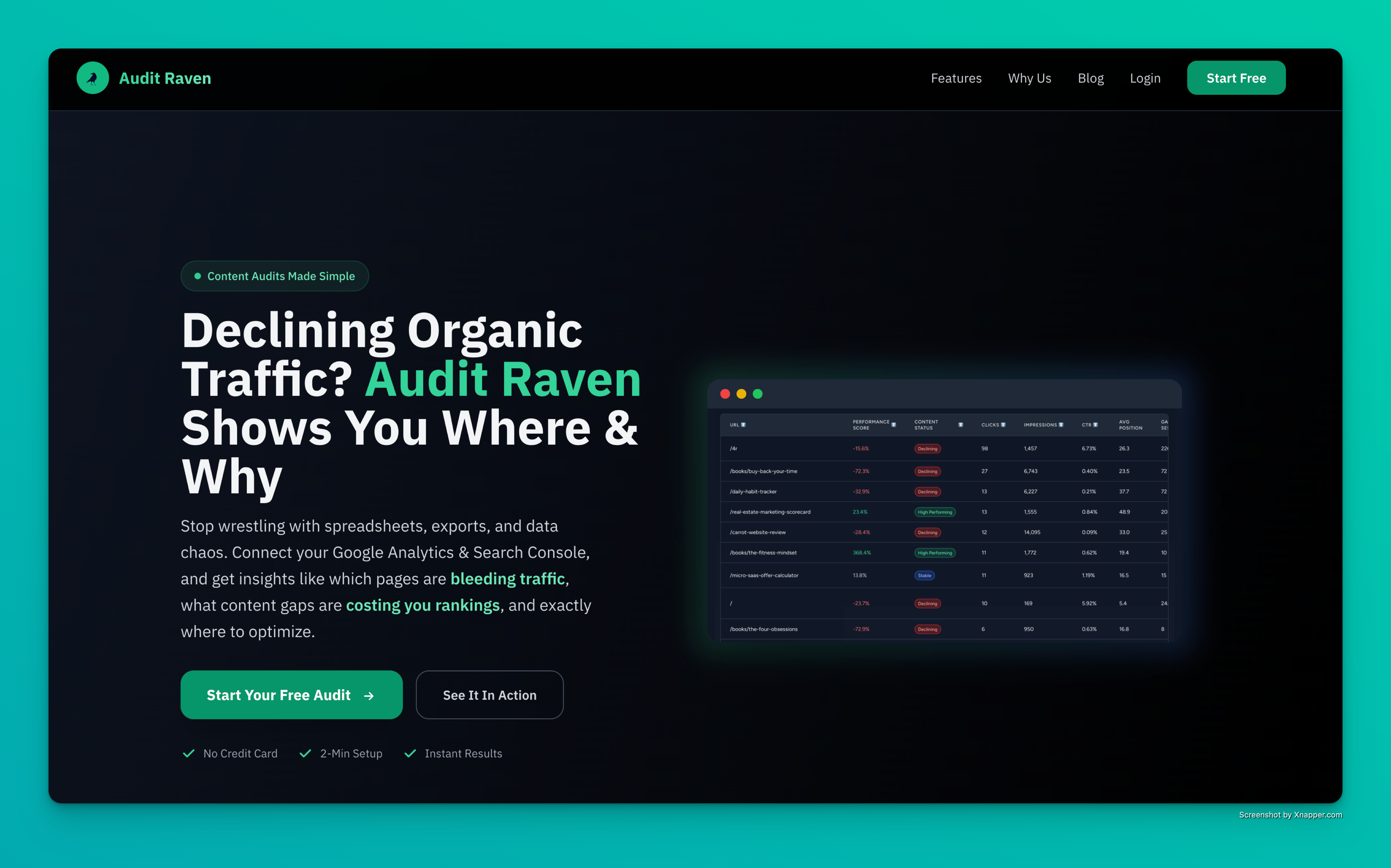
A simple SaaS that allows you to connect GA4 and GSC to perform a content audit to find keywords that need attention.
Project Details
Building Audit Raven
There are two ways I’ve found ideas for SaaS:
- Scratch your own itch. Build something that solves a problem you personally run into, and then see if others like you exist. That’s how I approached KeywordGaps.com.
- Start with research. Talk to people in the trenches, figure out what their pain points are, and see if there’s an angle to build something better, faster, or cheaper. That’s how AuditRaven.com came to be.
Problem discovery
I reached out to five people in my network who run SEO for clients. Instead of pitching them, I asked “mom test” style questions.
The reaction was immediate. Everyone lit up when content audits came up.
“This takes my team multiple days or even weeks for each client.”
“If there was a way to automate even half of this, we’d happily pay for it.”
The pattern was the same across the board: they were using Ahrefs or SEMrush, but still had to bolt on Screaming Frog + spreadsheets + pivot tables to actually produce a usable audit. It was slow, repetitive, and error-prone.
That was enough signal for me to start building.
Technical challenges
The first major hurdle: normalizing URLs between GA4 and GSC.
One tool gives you relative URLs, the other gives you full paths. To line them up, I had to stitch together four separate database tables and write a gnarly set of joins to get a clean view. That took longer than expected but once it clicked, it unlocked everything else.
The second hurdle: API scale.
Audit Raven enriches every URL with technical data from DataForSEO (meta title, canonical, word count, 404 status, etc.). Running hundreds or thousands of URLs through those API calls without hitting rate limits or timeouts was a serious pain. That was a few long nights of testing, retry logic, and error handling.
How Audit Raven works today
The user flow is simple on purpose:
- Sign in with Google SSO
- Connect GA4 and GSC
- Hit one button
Behind the scenes, Audit Raven pulls and merges all the data, runs it through DataForSEO, and builds the audit.
The core view shows all your URLs by status:
- Improving
- Stable
- Declining
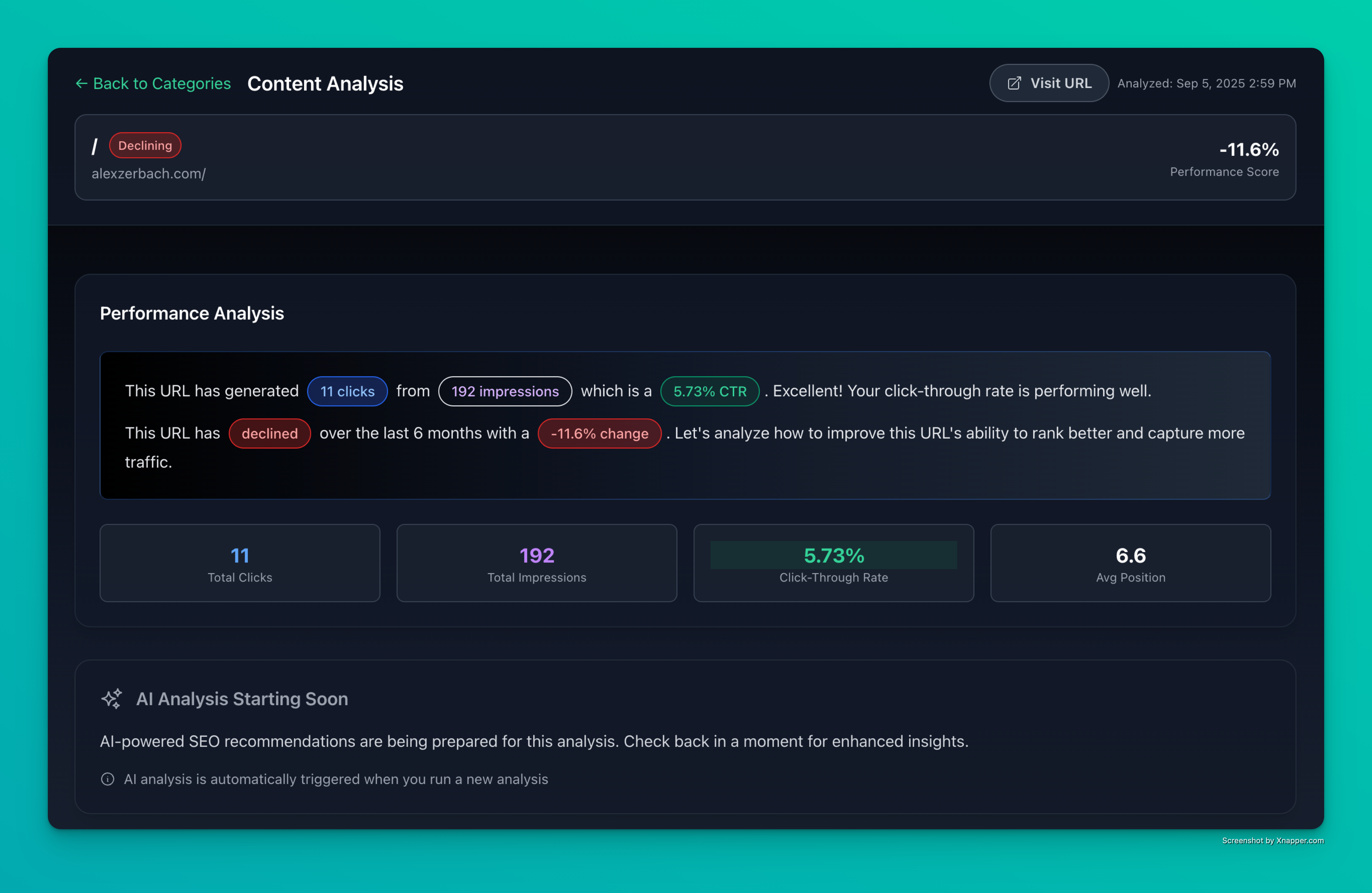
From there, you can click into any URL to run a one-off report. That fetches the top three competitors ranking for that query, compares their content to yours (word count, headings, content depth, etc.), and generates recs for how to improve.
User benefit
Instead of juggling exports from three tools and wrestling pivot tables, you get one clean dashboard.
The value isn’t just speed, though. Seeing URLs bucketed by status helps you focus on leverage points.
- A page marked “stable” might look fine at a glance, but digging deeper often shows it’s slowly declining on long-tail queries.
- With Audit Raven, you spot that sooner and fix it before it tanks.
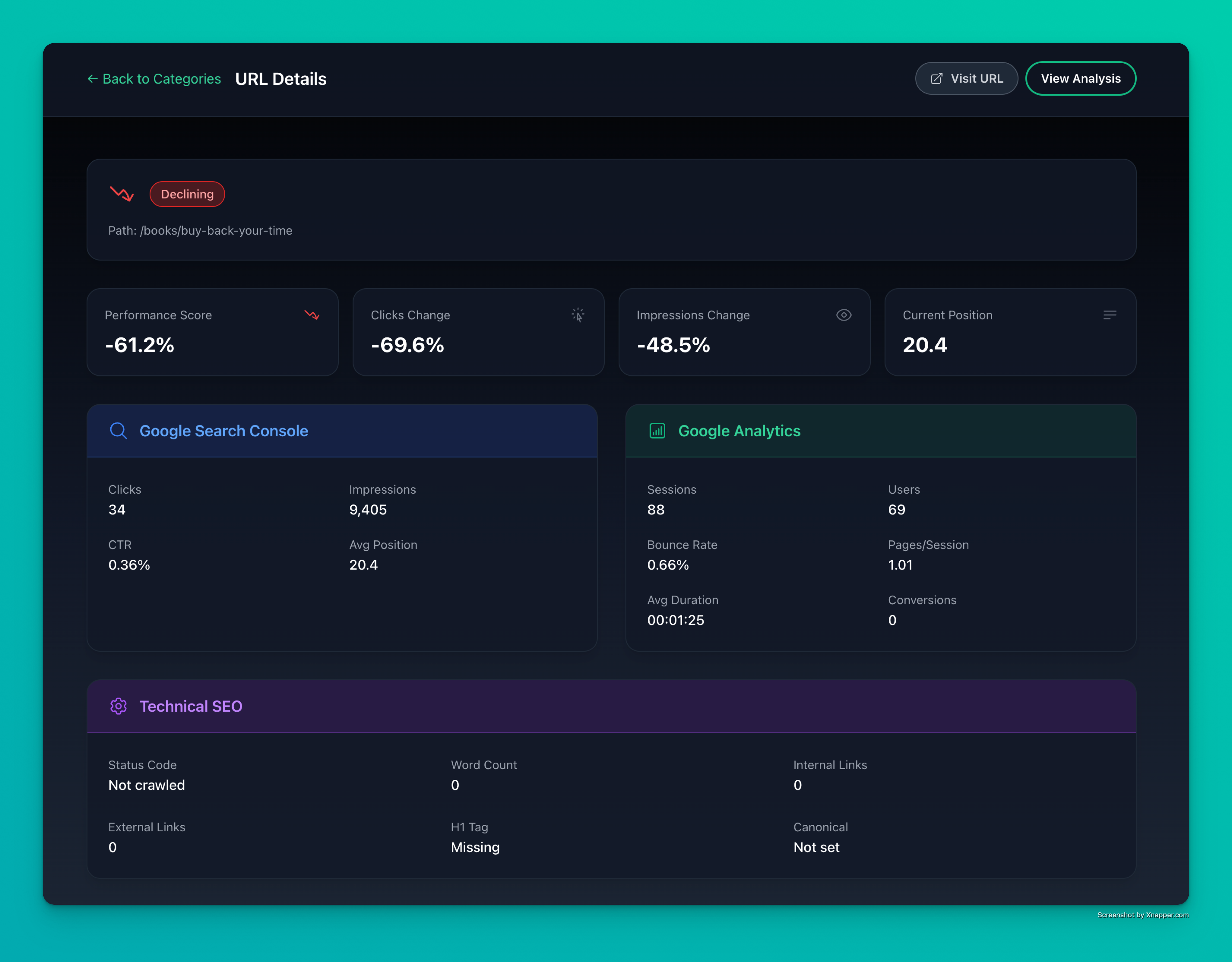
The competitor reports are the “aha” moment. Seeing a side-by-side of your content vs. the top three competitors makes the gap obvious: “oh, they all cover X and we don’t,” or “we’re at 500 words and they’re at 2,000.”
Lessons learned
KeywordGaps was built for me. Audit Raven was built from research. That contrast alone has been a huge learning experience.
A few takeaways so far:
- Pain signal matters. When five out of five people tell you something takes them days or weeks, you’re onto something.
- Technical hurdles are inevitable. GA4/GSC URL normalization was a mess, but solving it created defensibility.
- I’m cautious on scale. I haven’t marketed Audit Raven yet because I want to see how it handles large, messy sites (subdomains, tens of thousands of URLs, etc.).
Building for myself taught me speed. Building from research taught me signal. Both approaches have their place, but Audit Raven feels more “market-pulled” than anything else I’ve built.
What’s next
Right now Audit Raven works, but I’ve held back on actively marketing it until I see how it handles more complex sites (subdomains, thousands of URLs, etc.). Once I’m confident there, the plan is to start testing different growth channels.
Here’s where I’m starting:
- Twitter (build in public). I’ve been posting more of my work lately, and Audit Raven is a good candidate to share live progress, screenshots, and lessons as I go.
- Directories. SEO and marketing tool directories still send targeted traffic. Low-effort, long-tail exposure.
- Newsletter ads. I signed up for outrank.so and already have a backlog of blog posts in the works. Newsletter sponsorships in the SEO niche feel like a solid way to get early eyeballs.
- Google traffic. The irony of building an SEO audit tool is that I’ll need to rank for SEO-related queries myself. I’m treating my own site like a testbed for what the tool can do.
That’s the roadmap for now. The big question I’m asking: will people who say they’d happily pay actually pull out a credit card once it’s in front of them?
Either way, this is another experiment in building fast, shipping early, and learning in public.